
If you have spent even a week researching a 100 hour yoga teacher training Rishikesh course, you already know the feeling. Every website looks similar. Every school claims to be the most authentic, the most traditional, the most “spiritual.” And somewhere in between the glossy photos and the five-star review widgets, it becomes genuinely hard to tell what your actual experience will look like once you land.
This article is not here to tell you Rishikesh is a bad place to learn yoga. It isn’t. But it is not the only place, and it is worth knowing what you are really signing up for before you commit two or three weeks of your life and a fair amount of money to it. We are going to walk through what a typical 100 hour yoga teacher training Rishikesh program actually offers, where it quietly falls short, and why a quieter mountain town like Dharamshala — specifically a school like Mahiyoga School — might be the better fit for people who want more than just a certificate on a wall.
Why So Many People Default to Rishikesh First
Rishikesh has earned its reputation. It sits on the banks of the Ganga, it is where B.K.S. Iyengar and Swami Sivananda built much of what the modern yoga world now teaches, and it genuinely does have a long lineage of yoga schools, ashrams, and teachers. For a first-time searcher, “Rishikesh” and “yoga” feel like they belong together, and that association is not wrong.
The problem is scale. Over the last decade, the number of yoga schools packed into a few kilometres around Laxman Jhula and Tapovan has grown enormously. What used to be a handful of ashrams teaching small groups of serious students has turned into a dense strip of competing academies, many of them running monthly batches almost year-round. That growth has made yoga training in Rishikesh far more accessible — but accessibility and authenticity do not always travel together.
What a Typical 100 Hour YTTC in Rishikesh Actually Includes
Most 100 hour programs in Rishikesh follow a fairly similar template, regardless of which school you choose. Based on how these courses are typically structured:
- Duration: 8 to 14 days, depending on the school
- Daily hours: Roughly 6 to 10 hours of classes and self-study combined
- Core subjects: Hatha and Ashtanga asana, pranayama, meditation, basic anatomy, yoga philosophy, and an introduction to teaching methodology
- Accommodation: A mix of private rooms and shared dormitories, often ranging from 2-sharing up to 6-sharing rooms
- Meals: Sattvic vegetarian food, usually two to three meals a day
- Fees: Anywhere from roughly $350 to $650 depending on room type
- Certification: A school completion certificate that typically counts toward — but does not by itself qualify you for — Yoga Alliance’s RYT 200 registration
On paper, this looks complete. And honestly, for many students it is a genuinely good introduction to yoga. The issue is not the curriculum. It is everything around it.
The Honest Gaps Nobody Puts on the Homepage
1. Crowded Dorms Leave Little Room for Personal Growth
Walk through the accommodation pages of most Rishikesh schools and you will notice something: shared rooms are the default, not the exception. Four to eight people in one room is common, especially in the more affordable packages. That might sound fine when you are simply booking a course, but living it is a different story.
A teacher training is not a hostel trip. It asks you to sit with yourself, process what you are learning, and quietly integrate a lot of new information about your body and mind. That kind of reflection needs a bit of physical space and quiet, something that is genuinely hard to find when you are sharing a room with seven strangers on different sleep schedules, different routines, and different comfort levels. Personal space is not a luxury here — it is part of how the learning actually settles.
2. Concrete Next to Concrete Does Not Feel Very Spiritual
Search “Rishikesh yoga school” and look closely at the location pins. Many of these academies sit in tightly packed lanes, building after building, a few minutes’ walk from cafés, souvenir shops, and other competing yoga schools. The Ganga might be visible from a rooftop, but that is not quite the same as training beside it.
Very few schools are actually positioned inside natural surroundings — forest, hillside, or riverbank — despite what the marketing photography suggests. Most of those serene, nature-heavy images are shot during a single excursion day, not representative of where you will spend your daily 5:30 AM to 8 PM schedule. That gap between the marketing and the ground reality is one of the most common quiet disappointments students mention once they arrive.
3. The Business Model Has Started to Outweigh the Teaching Tradition
Traditionally, learning yoga meant sitting with a teacher who held you accountable — not just to a syllabus, but to the discipline and respect that comes with the practice itself. That relationship was slow, personal, and a little bit strict, in the way that any real mentorship tends to be.
What is happening in parts of Rishikesh now looks different. With schools running back-to-back monthly batches and competing heavily on price and volume, the emphasis has shifted toward throughput — get students in, get them certified, get them out, start the next batch. That is a business model, and there is nothing inherently wrong with running a business. But it does change the texture of the experience. The strict, deeply invested teacher who shapes not just your asana but your understanding and respect for the tradition becomes harder to find when a school is optimising for occupancy rather than individual attention.
None of this means every Rishikesh school is like this. Several genuinely maintain small batches and dedicated teachers. But the trend across the wider market is real, and it is worth going in with open eyes.
Why Dharamshala Is Worth Considering Instead
Dharamshala, tucked into the Dhauladhar range in Himachal Pradesh, offers a genuinely different rhythm — not because it is trying to compete with Rishikesh’s reputation, but because it simply operates on a smaller, quieter scale.
| Factor | Typical Rishikesh Experience | Typical Dharamshala Experience |
|---|---|---|
| Climate | Hot, humid, and dusty for much of the year | Cooler mountain air, pleasant even in summer months |
| Surroundings | Dense, built-up lanes near the main yoga strip | Pine forests, hillside views, closer to open nature |
| Crowd levels | Hundreds of competing schools in a small radius | Far fewer schools, less yoga-tourism saturation |
| Batch sizes | Often large, monthly, high-turnover | Typically smaller and more intimate |
| Atmosphere | Fast-paced, commercially driven | Slower-paced, closer to Himachali and Tibetan Buddhist culture |
The altitude and forest air alone make a noticeable difference to how your body responds to long pranayama and asana sessions. And the relative quiet of Dharamshala, away from the tourist density of the main Rishikesh strip, gives students the kind of stillness that a 100-hour immersion is supposed to be built around in the first place.
Where Mahiyoga School Fits In
This is exactly the gap that Mahiyoga School in Dharamshala tries to close. Rather than running large, high-turnover batches, the school keeps its groups intentionally small, so that the relationship between teacher and student stays close to what it was traditionally meant to be — attentive, a little demanding, and genuinely personal.
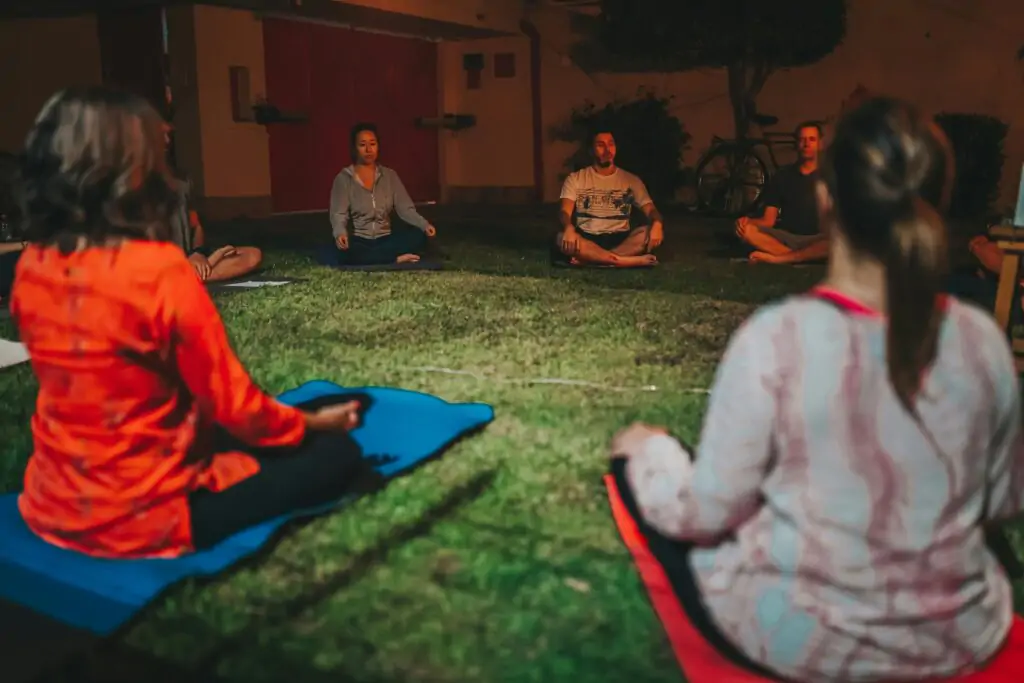
Students training here are surrounded by pine forest and mountain air rather than a row of neighbouring guesthouses, which makes a real difference to how grounded the daily practice feels. And because Dharamshala has not been saturated by yoga tourism the way Rishikesh has, the pace of the course — and of the town itself — stays closer to what most people are actually looking for when they say they want an “authentic” training.
If you are exploring the 100 hour yoga TTC in Dharamshala, it is worth comparing the batch sizes, room-sharing ratios, and daily schedule directly against what you have seen from Rishikesh schools. You will likely notice the difference immediately in how the course is structured around the individual student rather than the batch as a whole.
For those who want to go further afterward, it is also worth looking at the 200 hour yoga teacher training in Dharamshala, since many students choose to complete their full Yoga Alliance RYT 200 certification in the same calm environment rather than returning to a more crowded location for the second half of their training.
Rishikesh vs Dharamshala: A Fair Summary
To be clear, Rishikesh is not a poor choice. If you want a wide selection of schools, an established yoga-tourism infrastructure, easy travel connections, and the historical weight of the city, it remains a solid option — particularly if you already know exactly which school you want and have verified their batch sizes and location firsthand.
Dharamshala simply offers a different trade-off: fewer options to choose from, but a calmer setting, smaller class sizes at schools like Mahiyoga School, and an environment that leans more naturally toward reflection than tourism. For many first-time students, especially those who value personal attention and a genuine connection with nature over convenience and choice, that trade-off tips clearly in Dharamshala’s favour.
Quick Tips Before You Book Any 100 Hour YTTC
- Ask directly about room-sharing ratios — do not assume “shared accommodation” means two people
- Request recent, unedited photos of the actual training hall and surroundings, not just the marketing gallery
- Ask how many students are typically in one batch, and whether that number has grown in recent years
- Clarify exactly what your certificate will and will not qualify you for with Yoga Alliance
- If nature and quiet matter to you, ask how far the school is from the nearest commercial or tourist strip
Frequently Asked Questions
Not on its own. Most 100-hour courses give you a school completion certificate that counts toward the internationally recognised 200-hour RYT certification, but Yoga Alliance requires the full 200 hours before you can register as a certified teacher.
Both work well for beginners. Rishikesh offers more schools and easier travel logistics, while Dharamshala tends to offer smaller batches, cooler weather, and a quieter, more nature-immersed setting — which many first-time students find easier to settle into.
Course fees generally range between $350 and $700 depending on the school, room type, and location, usually including accommodation, meals, and study materials.
No. Most 100-hour programs, whether in Rishikesh or Dharamshala, are designed for complete beginners as well as practitioners who want to deepen an existing practice.
Yes. Most schools allow you to complete the remaining hours at a later date, either at the same school or elsewhere, to reach the full 200-hour Yoga Alliance requirement.
Final Thoughts
Choosing where to do your 100 hour yoga teacher training Rishikesh search first led you to is a personal decision, and there is no single right answer for everyone. But it is worth choosing with your eyes open — knowing what the crowded dorms, the concrete lanes, and the increasingly commercial batch schedules actually look like once you arrive, rather than only what the homepage photos promise.
If a slower pace, smaller batches, and genuine mountain surroundings sound closer to what you are looking for, it is worth putting Dharamshala — and a school like Mahiyoga School — on your shortlist before you book. Explore the 200 hour yoga teacher training in Dharamshala page for the next step, or reach out directly with your questions. Either way, take the time to compare properly. It is your training, your money, and your time — you deserve a course that actually matches what it promises.