
If you’ve typed “yoga courses in Rishikesh” into Google even once, you already know how overwhelming the search gets. Dozens of schools, all claiming to be the “best,” all promising the same riverside views and the same 200-hour certificate. It’s a lot of noise for a decision that’s supposed to be about finding stillness.
I’m not here to tell you Rishikesh is a bad choice. It genuinely isn’t. It has decades of yogic history, a huge teacher community, and more course options than anywhere else in India. But “the most popular place” and “the best place for you” aren’t always the same thing, and that gap is worth talking about honestly before you book a flight and pay a non-refundable deposit.
This article walks through what training in Rishikesh actually looks like today, why that experience has changed over the years, and why a quieter town in the Himalayan foothills — Dharamshala — is increasingly the better fit for people who want a real, personal, and undistracted yoga education.
What Yoga Courses in Rishikesh Actually Look Like Today
Rishikesh earned its reputation for good reason. It sits on the banks of the Ganga, surrounded by the Himalayan foothills, and it has been a serious center for yogic study for generations. That part hasn’t changed.
What has changed is the scale. Walk down any lane near Laxman Jhula or Tapovan today and you’ll pass one yoga school after another, often sharing a wall with the next one. Most reputable schools now run 100-hour, 200-hour, 300-hour, and 500-hour certifications side by side, plus add-on modules in Yin yoga, sound healing, Reiki, prenatal yoga, and Ayurveda — sometimes all under one roof, sometimes bundled into combo packages with names like “TTC + Panchakarma + Sound Healing.”
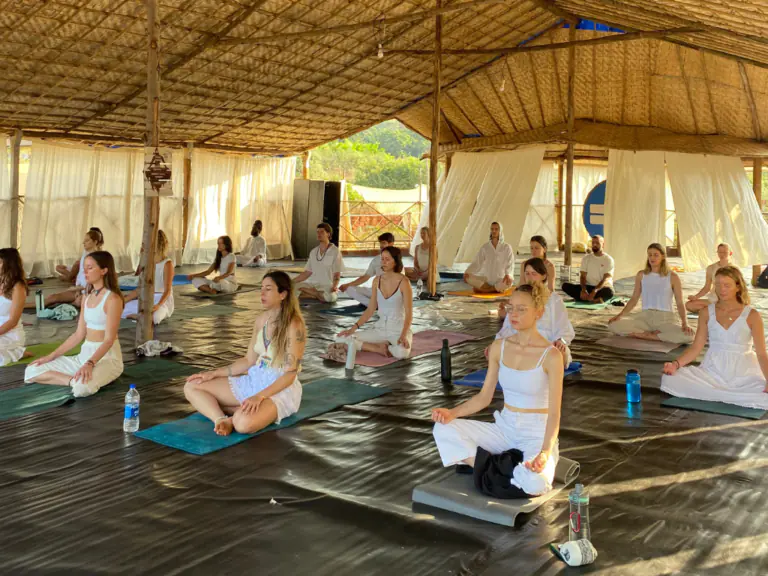
A few patterns show up again and again once you start comparing schools:
- Batch sizes are large. It’s common to see 20 to 30 students enrolled per course, with several courses running in parallel in different halls on the same campus.
- Rooms are usually shared. Private rooms exist, but they cost extra, and the default is a twin-sharing or multi-bed room — which is fine for some people, but not ideal if you’re hoping for quiet personal space to process what you’re learning.
- The campuses are dense. Even schools that describe themselves as “surrounded by nature” are often just a few meters from the next building, the next café, or the next spa. True open, natural space is rarer than the marketing photos suggest.
- The business side is very visible. Discount banners, seasonal offers, upsell pricing for A/C rooms, and long codes of conduct with fines and cancellation clauses have become standard. None of this makes a school illegitimate, but it does shift the feeling from “sacred learning space” to “well-run hospitality business.”
None of this means the teaching itself is bad — many Rishikesh schools genuinely have qualified, sincere teachers. But the environment around the teaching has become noticeably more commercial and more crowded than it was a decade ago, and that affects the experience more than most people expect before they arrive.
1. Crowded Dorms Leave Little Room for Personal Growth
A yoga teacher training course isn’t just physical practice — it’s meant to be a period of real introspection. That’s hard to do when your room sleeps four to eight people, your schedule is shared with 25 strangers, and quiet moments are rare because someone is always coming or going.
Shared rooms can build camaraderie, and plenty of students love that social side. But if part of your reason for doing a YTTC is to actually sit with yourself, journal, rest, or simply decompress, a packed dorm room works against that goal. Personal space isn’t a luxury in this context — it’s part of how the transformation actually happens.
2. Buildings Next to Buildings Don’t Feel Very Spiritual
Search any Rishikesh school’s photos and you’ll usually see a garden, a pool, maybe a rooftop view. Fair enough — these are nice amenities. But zoom out and you’ll often find that same peaceful garden is boxed in by the next school’s compound wall, a busy lane, or a row of shops just meters away.
Very few schools in Rishikesh are actually set inside forest or genuinely isolated from the town’s traffic and noise. Most are close to the Ganga in name — a short walk or a few kilometers — rather than immersed in it. That’s not a dealbreaker for everyone, but if you pictured your YTTC happening deep in nature, the reality in most of Rishikesh’s yoga district looks more like a busy urban campus than a forest retreat.
3. Yoga Schools Are Increasingly Run Like Businesses
There’s nothing wrong with a school being well-organized. But somewhere along the way, many Rishikesh schools started to feel less like an ashram guided by a teacher and more like a franchise guided by a sales calendar. Limited-time discounts, upsell packages, multiple international branches, and long legal disclaimers have become the norm rather than the exception.
The old model — a strict, dedicated teacher who pushes you not just to learn asana but to genuinely respect the tradition — is harder to find in that environment. When a school is managing dozens of course variants across several countries at once, it’s difficult for that same intimate, disciplined teacher-student relationship to survive. Traditional yoga was never meant to be a menu of add-ons; somewhere in the growth, that seems to have gotten lost for a lot of schools.
Why Dharamshala Is a Genuinely Better Fit for Many Students
Dharamshala isn’t trying to compete with Rishikesh’s scale, and that’s exactly the point. It offers something different — and for many students, something better suited to what a yoga teacher training is actually supposed to be.
| Factor | Typical Rishikesh Experience | Typical Dharamshala Experience |
|---|---|---|
| Climate | Hot, humid plains climate for much of the year | Cooler mountain climate at higher altitude, comfortable most months |
| Setting | Riverside town, but often dense and built-up near the schools | Forested hillsides with pine and deodar trees, more open space |
| Crowd levels | Dozens of competing schools clustered together | Far fewer schools, less tourist saturation |
| Cultural depth | Yogic tradition, plus an active tourist and adventure-sports economy | Yogic tradition alongside a living Tibetan Buddhist meditative culture |
| Teacher access | Larger batches, often 20–30 students | Smaller, boutique-style classes are more common |
| Pace of life | Busy, transactional, tourist-driven | Slower, quieter, more contemplative |
To be fair, Rishikesh does have real advantages Dharamshala can’t fully match — easier flight and train access via Dehradun and Haridwar, a longer-established teacher network, and the historical weight of being called the “Yoga Capital of the World.” Those things matter to some students, especially if convenience and a wide course catalog are top priorities.
But if what you actually want is a quieter, greener, more personal environment to study in, Dharamshala’s cooler mountain air, forested surroundings, and smaller student communities tend to deliver exactly that.
Mahiyoga School: A Different Kind of Yoga Course in Dharamshala
This is where Mahiyoga School comes in. Rather than trying to be the biggest name in the region, Mahiyoga has built its programs around the things that tend to get lost in bigger, busier campuses: small groups, real access to teachers, and a setting that actually feels removed from noise and crowds.
If you’re comparing options, here’s what tends to stand out about training with Mahiyoga:
- Smaller batches mean your teacher can actually correct your alignment, answer your questions, and notice when you’re struggling — not just move through a checklist for 25 people.
- A genuinely quieter campus, set among the pine forests of the Dhauladhar foothills rather than squeezed between neighboring buildings.
- A cooler, more comfortable climate for daily practice, without the heavy heat and humidity that many students find draining in Rishikesh for parts of the year.
- A grounded, traditional teaching style, where the emphasis stays on discipline and depth rather than upsells and add-on packages.
Students who complete the 200-hour yoga teacher training in Dharamshala with Mahiyoga often describe it as feeling less like attending a program and more like actually living the practice for a few weeks — which, frankly, is what a YTTC is supposed to feel like.
For those who already hold a 200-hour certification and want to go deeper, the 300-hour yoga teacher training builds on that same small-group, low-distraction approach. And if you’re not ready to commit to a full certification yet, Mahiyoga’s yoga retreats in Dharamshala are a good way to experience the school and the region before making a bigger decision.
Rishikesh vs. Dharamshala: Which Should You Choose?
There’s no single right answer here — it depends on what you’re actually looking for.
Choose Rishikesh if:
- You want the widest possible range of course styles and durations in one place
- Easy travel logistics and a big, established yoga scene matter to you
- You enjoy a busier, more social atmosphere with lots of fellow travelers around
Choose Dharamshala if:
- You want smaller classes and more direct access to your teacher
- A quieter, cooler, forest-adjacent setting appeals to you more than a riverside town
- You’re looking for a slower pace and a stronger sense of personal space during your training
Both places can produce excellent, capable yoga teachers. The difference isn’t really about which location is “more authentic” in some abstract sense — it’s about which environment actually supports the kind of learning and reflection you’re hoping to get out of the experience.
Frequently Asked Questions
Yes. Dharamshala works well for beginners because smaller class sizes mean more individual attention, which is especially helpful if you’re new to structured yoga study.
Dharamshala sits at a higher altitude and stays noticeably cooler than Rishikesh, especially in the pre-monsoon months when the plains around Rishikesh can get very hot and humid.
No. Most 200-hour programs, including those at Mahiyoga School, are designed to take complete beginners through to a confident, teaching-ready level.
Generally, yes. Dharamshala has far fewer yoga schools overall, and the town’s slower tourism pace means less competition for space, quiet, and teacher attention.
Yes, reputable schools in Dharamshala, including Mahiyoga School, offer certifications that are recognized internationally, allowing graduates to teach worldwide.
Ready to Experience a Quieter Way to Learn Yoga?
If the idea of training somewhere calmer, greener, and genuinely personal sounds like what you’ve been looking for, it might be worth looking beyond the usual yoga courses in Rishikesh search results. Explore Mahiyoga School’s course offerings, read through student experiences, and see whether Dharamshala’s slower pac Ready to Experience a Quieter Way to Learn Yoga?
If the idea of training somewhere calmer, greener, and genuinely personal sounds like what you’ve been looking for, it might be worth looking beyond the usual yoga courses in Rishikesh search results. Explore Mahiyoga School’s course offerings, read through student experiences, and see whether Dharamshala’s slower pace is the right fit for your own yoga journey.e is the right fit for your own yoga journey.