
Have you ever finished a yoga class feeling completely different from when you walked in — not just loosened up, but somehow more settled, more whole? Part of what you experienced might not have been your muscles at all. It could have been your fascia.
Fascia (pronounced FAH-sha) is one of the most fascinating and least talked-about structures in the human body. For years, it was sidelined in anatomy textbooks — literally scraped away during dissections to get to the “important stuff” underneath. Today, thanks to a growing body of research, we know that was a mistake. Fascia is not filler. It is a living, sensing, force-transmitting network that touches everything inside you — and understanding it can completely change the way you teach and practice yoga.
This article breaks down what fascia is, how it works, why it matters on the mat, and what every yoga teacher and practitioner should keep in mind when they step into the studio.
What is Fascia? A Simple Explanation
Fascia is a category of soft connective tissue that surrounds, separates, and connects virtually every structure in the body — muscles, bones, organs, nerves, and blood vessels included. Picture a three-dimensional web woven throughout your entire interior. That web is your fascial system.
The Latin root of the word is fascia, meaning “band” — and that image is surprisingly accurate. This tissue bands everything together while simultaneously keeping structures separate enough to move independently.
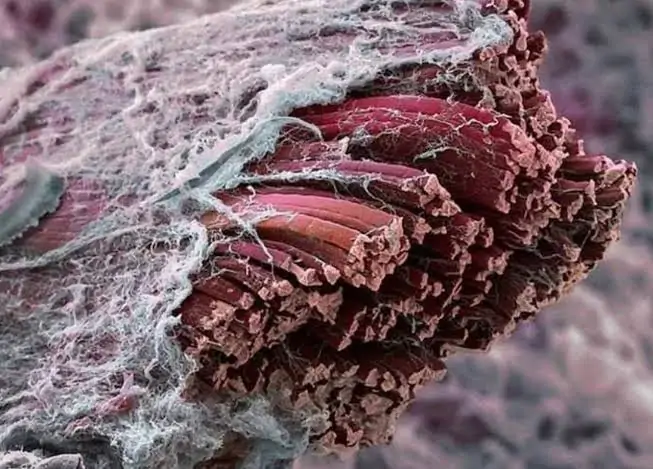
The Three Main Layers of Fascia
| Layer | Location | Key Role |
|---|---|---|
| Superficial fascia | Directly beneath the skin | Contains fat, nerve endings, and blood vessels; responds to gentle touch |
| Deep fascia | Wraps around muscles and muscle groups | Most directly engaged during yoga postures |
| Visceral fascia | Surrounds and suspends organs | Maintains organ position and allows independent movement |
These layers are not isolated. They are continuous — blending into one another and into tendons, ligaments, and joint capsules. A restriction in one area can create tension or discomfort that shows up somewhere else entirely. This is why a student with chronic hip tightness often also reports nagging lower back pain or limited shoulder mobility.
What Fascia Is Made Of
Fascia is composed of:
- Collagen fibres — provide tensile strength and resist pulling forces
- Elastin fibres — allow the tissue to spring back after being stretched
- Ground substance — a hydrated, gel-like matrix that surrounds the fibres and enables adjacent tissue layers to glide smoothly against each other
That last point matters more than it might seem. When the body is dehydrated or held in the same position for long periods, this ground substance thickens and loses its slippery quality. Movement stiffens. Gliding becomes grinding. A consistent yoga practice — especially one that includes varied movement, breath, and hydration — helps keep this matrix fluid and responsive.
Why Traditional Anatomy Missed the Point
Most yoga teacher training programs still build their anatomy curriculum around the muscle-bone-joint model. You learn which muscles attach where, which nerves serve which muscles, and how joints create leverage. This is genuinely useful knowledge — but it tells only part of the story.
The traditional model treats muscles as individual units that pull bones in specific directions. What it leaves out is the connective tissue architecture that links those muscles into longer chains, transmits forces across the body, and gives the whole system its elastic, responsive quality.
Fascia does not replace what you already know about the musculoskeletal system. It expands it. When you understand that muscles and their fascial sheaths are so inseparable that researchers now use the term myofascial unit, you start to see why a tight calf can affect the back of the knee, why restriction along the back of the leg shows up in the lower back, and why no yoga posture is ever truly a “local” event.
Fascia and Myofascial Chains: The Body as a Connected System
One of the most significant contributions of fascia research to yoga is the concept of myofascial chains — long lines of connected tissue that transmit force and tension through the body in predictable paths.
Thomas Myers’ landmark work Anatomy Trains mapped several of these lines, showing how tension can travel from the sole of the foot all the way to the base of the skull, or from the front of the hip up through the chest and neck. Not all of these proposed chains have been equally verified by research, but the superficial back line — which runs along the rear of the body from the plantar fascia to the scalp — has solid anatomical support.
What This Means in Practice
Take Pigeon Pose, one of the most commonly taught hip openers. Seen through a purely muscular lens, it targets the piriformis and the external hip rotators. But from a fascial perspective, it also loads a network of connective tissue along the outer hip, into the IT band, and down toward the knee. This is part of why practitioners sometimes feel sensation far from the “target” — and why the same pose can occasionally aggravate an existing knee or wrist issue if it is approached without awareness of these longer lines.
Understanding myofascial continuity allows teachers to:
- Offer more informed modifications and cues
- Explain why sensation in a pose might be felt in unexpected places
- Sequence classes that address the body as a connected whole rather than a collection of parts
Fascia as a Sensory Organ: Proprioception and the Sixth Sense
Here is something that often surprises people when they first learn it: fascia is one of the most richly innervated tissues in the body. It contains a dense network of sensory nerve endings — mechanoreceptors, nociceptors (pain-sensing nerves), and proprioceptive endings — all in constant conversation with the brain.
Proprioception is your body’s ability to sense its own position in space without using your eyes. The word comes from the Latin proprius, meaning “one’s own,” plus ception from perception. So it literally translates as “self-perception.” It is what lets you type without looking at the keyboard, balance in Tree Pose with your eyes closed, and move through the world without constantly bumping into things.
Your fascial system is a primary home for this sense. Research has found a meaningful link between the quality of proprioception — how clearly your brain can map your body — and lower levels of chronic pain. The more accurately the nervous system can sense the body, the better it can coordinate movement and the less likely it is to interpret input as threatening.
This is one of the reasons yoga works. A slow, attentive practice that asks you to notice sensation, adjust alignment, and hold positions mindfully is proprioceptive training in the deepest sense. You are not just stretching tissue. You are refining your nervous system’s inner map.
How Yoga Affects the Fascial System
Understanding fascia helps explain several things that experienced practitioners observe but struggle to articulate.
Movement Variety Keeps Fascia Healthy
Fascia grows stronger and more resilient when it experiences a wide variety of loads and directions of movement. Repetitive stress in only one plane — the same vinyasa sequence every day, hours at a desk, or running the same route — causes the tissue to adapt by becoming denser and less adaptable in other directions. This is when cross-linking and adhesion can develop between tissue layers.
A yoga practice that includes forward folds, backbends, lateral stretches, twists, and inversions challenges the fascial network in multiple planes and keeps it adaptable.
Long Holds Work Differently Than Quick Stretches
Fascia responds to slow, sustained loading rather than rapid, dynamic stretching. This is the physiological backbone of Yin Yoga. A passive hold of three to five minutes at a mild to moderate intensity creates a gradual change in the tissue’s viscoplastic properties — meaning it slowly shifts and reorganizes under sustained gentle pressure.
This is quite different from what happens in active muscle stretching, where the nervous system is the primary factor in determining range of motion. Both types of practice serve different purposes and complement each other well in a balanced schedule.
Compression and Release Hydrate the Tissue
The ground substance of fascia is water-loving by nature. Movement — especially the compression and release cycles common in yoga — pumps fluid through the fascial matrix, keeping it viscous and allowing tissue layers to glide past one another smoothly. This is one reason students often feel noticeably more mobile after class even in the first few minutes of movement, before the body has truly “warmed up.”
Staying well hydrated before and after class supports this process directly.
Postural Habits Shape the Fascial Architecture
The fascia body type — the way the fascial network adapts over time to the positions and movements that are most habitual — is profoundly shaped by daily posture and repetitive patterns. Someone who sits at a desk for eight hours a day will develop fascial adaptations that reflect that position: tightening along the front of the body, gradual shortening around the hip flexors, and compression along the thoracic spine.
Yoga does not instantly reverse these patterns, but a consistent practice — one that consciously brings the body into positions it rarely visits in daily life — gradually rebalances these fascial loads over weeks and months.
Why Yoga Teachers Need to Understand Fascia
The implications for teaching are significant. When you understand that the body communicates through connected lines rather than isolated muscles, several things shift.
Cueing Becomes More Holistic
Instead of cueing a student to “stretch the hamstrings,” you might invite them to “send energy through the heel and lengthen the back of the leg from the base of the skull all the way to the sole of the foot.” This activates the superficial back line as a connected unit and gives students a richer, more accurate experience of what is happening in the pose.
Injury Prevention Gets Smarter
Many common yoga injuries — including knee or wrist pain — can be understood more clearly through a fascial lens. If a student reports pain at the inner knee during Pigeon Pose, the source of the problem may not be at the knee itself. It may be a lack of external rotation range at the hip, poor load distribution along the lateral fascial line, or inadequate support in the transitions. Understanding fascial connectivity helps you ask better questions and offer more targeted modifications.
Sensation in Class Becomes a Teaching Tool
When students describe a deep, diffuse, sometimes emotional feeling during long-held poses — particularly hip openers and forward folds — that experience is most likely coming from fascial mechanoreception, not purely from muscle tissue. Fascia is richly innervated and genuinely sensitive. Teaching students to relate to that sensation with curiosity rather than alarm is one of the most valuable things a knowledgeable teacher can offer.
Practical Tips for Fascia-Informed Yoga Practice
| Principle | Practical Application |
|---|---|
| Move in multiple planes | Vary your practice — include lateral bends, spirals, and diagonal patterns |
| Hydrate consistently | Drink water before and after practice to support fascial ground substance |
| Include long holds | Practice Yin-style holds of 3–5 minutes to target connective tissue layers |
| Build gradually | Fascial adaptation takes weeks to months — avoid rushing into deep range of motion |
| Rest and recover | Fascia remodels during recovery; sleep and rest days matter as much as practice |
| Address whole chains | Warm up related areas before deep poses (e.g., calves and hamstrings before deep hip openers) |
Frequently Asked Questions
Fascia is a network of soft connective tissue that runs throughout the entire body, surrounding and connecting muscles, bones, organs, nerves, and blood vessels. It is continuous, three-dimensional, and richly innervated, making it both a structural and a sensory system.
Muscles are composed of contractile fibres that generate force. Fascia is the connective tissue matrix that surrounds, invests, and links those muscles — as well as every other structure in the body. The two are so intertwined that the compound term “myofascial unit” is often used to describe a muscle together with its fascial wrapping.
Yes, though the mechanisms and timelines differ from muscular adaptation. Long, slow holds and varied multi-directional movement are particularly effective. Research suggests that fascial remodelling in response to habitual loading occurs over weeks and months, not days.
Fascia is densely innervated with sensory nerve endings, including autonomic (involuntary nervous system) fibres. Poses that create sustained, novel sensation in richly innervated fascial tissue can trigger autonomic responses — shifts in breathing, heart rate, or emotional tone. This is a real physiological event, not imagination.
Fascia contains nociceptive nerve endings that can generate their own pain signals when the tissue becomes restricted, dehydrated, or chronically loaded in one direction. It can also alter how load is distributed through the body, placing compressive stress on joints. Addressing fascial health through varied movement, hydration, and consistent practice can meaningfully reduce some forms of chronic discomfort.
Conclusion: A Whole-Body Perspective Worth Embracing
Understanding fascia does not require you to throw out everything you learned in anatomy training. It asks you to expand it — to see the body not as a collection of independent parts but as a continuous, integrated, self-sensing system.
When you teach with this understanding, your cues become richer. Your modifications become smarter. And your students begin to experience what yoga has always offered: not just flexibility or strength, but a deepened sense of being at home in their own body.
If you found this article useful, explore our related guides on Anatomy, the Fascia Body Type, safe practice for Knee/Wrist Pain, and how to approach poses like Pigeon Pose with greater confidence and care. Share this article with a fellow teacher or practitioner who could benefit — and if you have questions or insights of your own, leave them in the comments below.