Walk into almost any studio schedule and you’ll spot them sitting side by side: Yin Yoga and Restorative Yoga. Both look slow. Both use a small mountain of props. Both promise to help you unwind. So it’s no surprise that so many students quietly wonder whether they’re really two different classes — or just two different names for the same thing.
They are not the same, and understanding Yin vs Restorative can completely change how you plan your week on the mat. One practice quietly challenges your tissues; the other asks you to do almost nothing at all. Knowing which is which means you’ll stop guessing which class to book and start choosing the one your body is actually asking for.
This guide breaks down what happens in each style, how the intentions differ, and how to decide between them depending on your energy, your goals, and even your health history.
The Quick Answer
If you only have thirty seconds, here’s the short version:
| Yin Yoga | Restorative Yoga | |
|---|---|---|
| Main goal | Gently stress connective tissue to improve mobility | Fully support the body so it can rest and recover |
| Typical hold time | 3–7 minutes | 5–20 minutes (savasana often longer) |
| Effort level | Find an “edge,” stay present with sensation | Let go completely, minimal sensation |
| Props | Used to find and support the edge | Used to remove all effort from the body |
| Best for | Healthy bodies wanting deeper flexibility and stillness practice | Stress, burnout, injury recovery, illness, pregnancy |
Now let’s look at why these differences matter.
What Is Yin Yoga, Exactly?
Yin Yoga is a quiet but physically deliberate practice built around three simple principles: finding an appropriate edge, settling into stillness, and staying there for several minutes at a time. Instead of moving through muscle-driven, “yang” style shapes, you sink into poses like a supported dragon lunge, a seated forward fold, or a reclined butterfly, and allow gravity — not effort — to do the work.
Because holds typically last anywhere from three to seven minutes, the practice reaches past the muscles and into the deeper connective tissues: fascia, ligaments, and joint capsules. Over time, this mild, sustained loading helps these tissues stay supple and well hydrated, which is why so many long-time practitioners report better mobility and fewer nagging aches.
Yin is also, quietly, a mental practice. Holding a pose for five minutes with nothing to distract you tends to surface whatever you’ve been avoiding — restlessness, impatience, or simply the urge to fidget. Learning to stay soft and breathe through that discomfort is arguably the real skill being trained.
What a Typical Yin Class Feels Like
- Fewer, longer-held poses (often only 5–8 poses in a full class)
- Floor-based shapes: forward folds, hip openers, gentle twists, supported backbends
- Props used to help you find a sustainable edge, not to eliminate sensation entirely
- A noticeable, mild ache or pulling sensation that you’re invited to breathe into
- A meditative, introspective tone throughout
Teachers who build their own Yin Sequences usually design a class around one area of the body — hips, spine, or shoulders — so that the tissues in that region are worked from several angles before class ends.
What Is Restorative Yoga, Exactly?
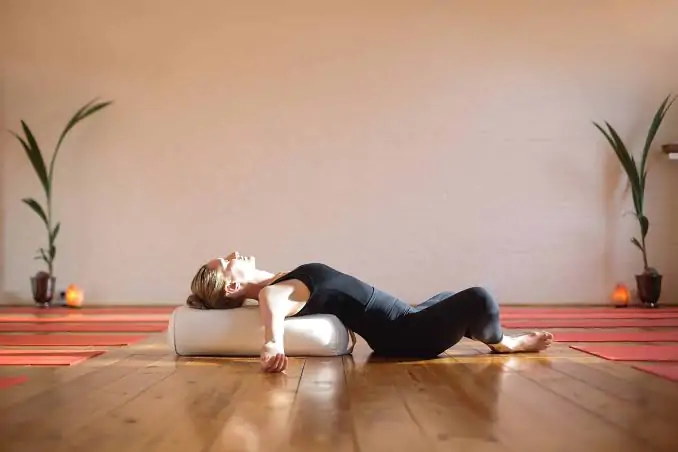
Restorative Yoga takes the opposite approach to effort. Where Yin invites you to find an edge, Restorative removes the edge altogether. Every pose is heavily propped with bolsters, blankets, and blocks so that no muscle needs to engage at all. The body is arranged, supported, and then left completely alone.
The goal isn’t flexibility or tissue change — it’s nervous system recovery. When the body feels fully held, with nothing left to hold up or stretch toward, it can shift out of a stress response and into deep rest. This is why Restorative classes are so often recommended for people dealing with burnout, poor sleep, illness, injury recovery, or major life stress.
Poses are held for much longer than in Yin — often five to twenty minutes — and a Restorative class may move through only three or four shapes in an entire hour. Savasana, the final resting pose, is frequently extended to fifteen or twenty minutes, since that’s roughly how long most people need to truly let go.
What a Typical Restorative Class Feels Like
- Very few poses, each fully supported by props
- Reclined or seated shapes: supported bridge, legs-up-the-wall, bolstered child’s pose
- Dim lighting, blankets for warmth, and often an eye pillow
- Little to no physical sensation — comfort is the entire point
- A slow, quiet, almost sleepy atmosphere
Yin Yoga vs Restorative Yoga: The Core Differences
The confusion between these two styles usually comes down to three things: intention, intensity, and audience.
1. Intention Yin Yoga is designed to place a healthy, moderate stress on connective tissue so it adapts and improves over time. Restorative Yoga is designed to remove stress entirely so the nervous system can downshift. One is subtly training the body; the other is actively soothing it.
2. Intensity and sensation In Yin, some sensation is expected and even welcomed — it’s a sign the tissue is being engaged. In Restorative, sensation is a sign something needs adjusting. If a Restorative pose is uncomfortable, a prop is added or removed until it isn’t.
3. Who each practice suits best Yin Yoga generally works well for reasonably healthy bodies looking to build mobility, patience, and stillness. Restorative Yoga is better suited to anyone who is unwell, injured, exhausted, pregnant, or simply overwhelmed and needs their body taken out of the equation for a while.
That said, the line isn’t always rigid. A slower, more heavily supported Yin class can start to feel restorative, and a teacher working one-on-one with an injured student might use Yin-style shapes at a much gentler intensity than a regular Yin class. Context, and the teacher’s judgment, matter as much as the label on the schedule.
Which One Should You Choose?
Ask yourself these three questions before booking a class:
- Am I generally healthy, just tight or stiff? → Yin Yoga will likely serve you well.
- Am I exhausted, stressed, injured, or recovering from something? → Restorative Yoga is the safer, more nourishing choice.
- Am I not sure, or somewhere in between? → Try both over a couple of weeks and notice how your body responds afterward. Most practitioners naturally gravitate toward whichever style matches their current season of life.
Many long-term yogis end up practicing both — Yin on days they want to work with sensation and mobility, and Restorative on days they simply need to disappear into a bolster for twenty minutes.
A Note for Teachers
If you teach yoga, the distinction matters even more. Teaching Yin to a room of mixed-ability students means calibrating for the average healthy body, while a student who is injured, pregnant, or managing a chronic condition often needs a more individualized, restorative-style approach instead. A useful rule of thumb: if a pose needs to be modified so heavily that it no longer resembles Yin, it’s probably time to borrow from Restorative principles instead. Thoughtful sequencing, clear cueing, and checking in with students throughout class go a long way toward keeping either style safe and effective.
Bringing Both Practices Together
Rather than treating Yin Yoga and Restorative Yoga as competitors, it helps to see them as two tools in the same kit. Yin builds resilience in your tissues and teaches you to sit with discomfort. Restorative teaches you to let go completely and rebuild from a place of deep rest. A well-rounded practice makes room for both, shifting between them depending on what a given week — or a given day — actually calls for.
Frequently Asked Questions
Generally, yes. Yin Yoga asks you to hold a mild stretch with sensation for several minutes, which takes more focus and tolerance than the fully supported, low-sensation poses used in Restorative Yoga.
Absolutely. Both styles are beginner-friendly since there’s no fast-paced movement or complex flow to learn. The main skill required is patience, not flexibility or strength.
Restorative Yoga is typically the better choice for acute stress or anxiety, since its entire purpose is calming the nervous system. Yin Yoga also lowers stress over time but works more gradually through longer, more engaged holds.
It depends on the injury and how the class is taught. Many people recovering from an injury do better in a Restorative class, or in a Yin class where the teacher is experienced in offering safe modifications.
Once or twice a week is enough for most people to notice benefits, though there’s no harm in practicing more often, especially during particularly stressful or demanding periods.
Final Thoughts
Yin Yoga vs Restorative Yoga isn’t really a competition — it’s a choice between two different kinds of care. Yin invites you to lean gently into discomfort and grow through it. Restorative invites you to let go of effort altogether and simply be held. Whichever one you choose today, both are valid ways of listening to what your body needs.
If you’re ready to go deeper, explore our library of Yin Sequences for at-home practice, or browse our full guide to Restorative Yoga to build a class around true rest. And if you teach yoga yourself, our resource on Teaching Yin covers how to sequence and cue this practice safely for every level in the room.
Found this helpful? Share it with a fellow yogi who’s been asking the same question, and drop a comment below with which practice you’re reaching for this week.