
You climb into bed exhausted, close your eyes — and your mind instantly races. Sound familiar? Millions of people struggle to fall asleep or stay asleep, not because they aren’t tired, but because their body and nervous system are still stuck in “go” mode.
Yoga poses for good sleep offer a proven, natural way to break this cycle. In just 10 to 20 minutes before bed, a gentle yoga practice can ease physical tension, slow your breathing, and shift your brain from stress into rest. Unlike sleeping pills or scrolling your phone, bedtime yoga addresses the root cause of sleeplessness — a body and mind that haven’t fully switched off.
In this guide, you’ll discover the best yoga poses for sleep, why they work, how to build a simple bedtime routine, and how practices like Yoga Nidra and Meditation can deepen your rest even further.
Why Yoga Works for Sleep
Yoga is far more than stretching. It blends controlled movement, focused breathing, and present-moment awareness — a combination that directly counteracts the tension patterns that keep you awake.
Here’s what the science says:
- Activates the parasympathetic nervous system. Deep, slow breathing during yoga signals your body to exit “fight-or-flight” mode and enter “rest-and-digest.” This slows your heart rate, lowers blood pressure, and sets the stage for deep sleep.
- Reduces cortisol. Regular yoga practice is associated with lower levels of cortisol, the primary stress hormone that disrupts sleep architecture.
- Releases physical tension. Areas like the lower back, hips, and neck hold enormous amounts of stored tension after a day of sitting, commuting, or stress. Targeted poses decompress those areas before you lie down.
- Improves sleep quality and duration. Research published in peer-reviewed journals confirms that a consistent bedtime yoga routine can reduce the time it takes to fall asleep, decrease nighttime wake-ups, and improve overall sleep satisfaction — even in people with chronic insomnia.
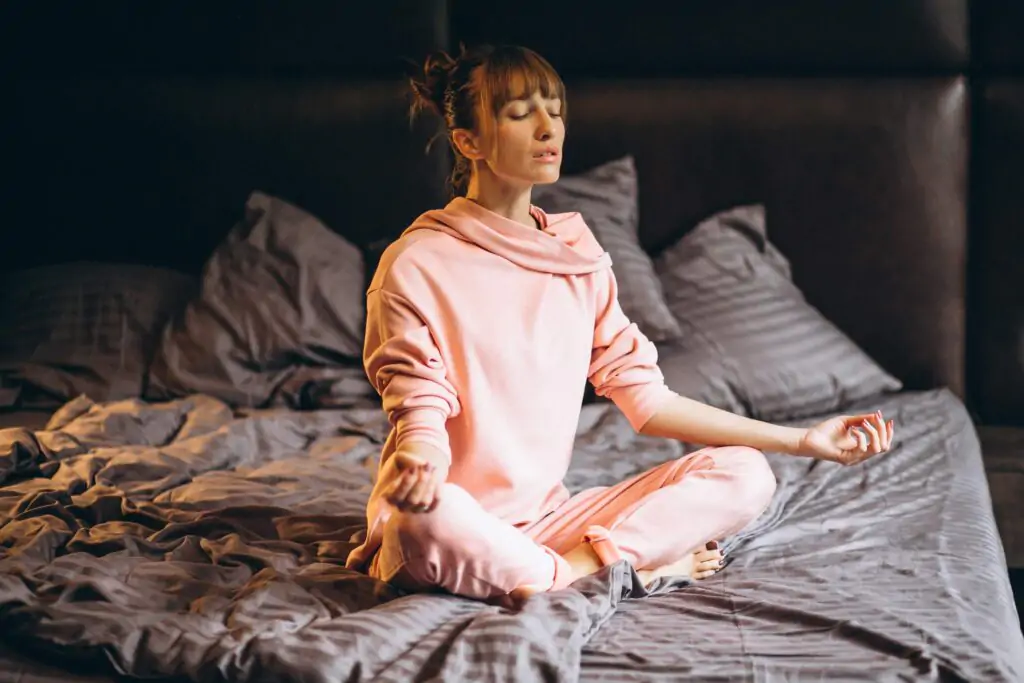
- Builds mind-body awareness. Yoga teaches you to notice when your body is holding tension, and to consciously release it — a skill that becomes easier and faster the more you practice.
The result? You don’t just feel sleepier after yoga. You reach sleep more easily, stay asleep longer, and wake up feeling genuinely restored.
The Best Yoga Style for Bedtime
Not all yoga is created equal when it comes to sleep preparation. Avoid energetic styles like Vinyasa flow, Ashtanga, or power yoga close to bedtime — these raise your core body temperature and heart rate, the opposite of what you need.
Instead, choose:
| Style | Why It Works for Sleep |
|---|---|
| Yin Yoga | Long-held passive poses (2–5 mins) that deeply release connective tissue and calm the nervous system |
| Restorative Yoga | Fully supported poses using props; designed to trigger the body’s relaxation response |
| Gentle Hatha Yoga | Slow, simple poses with focused breathing — perfect for beginners |
All three styles work beautifully with a short Meditation or breathing practice at the end, helping you cross the threshold from wakefulness to sleep.
10 Yoga Poses for Good Sleep
These poses are arranged to flow naturally from one to the next. You can do all ten or simply pick your favourites. Each one can be done on a yoga mat beside your bed — or even in bed itself.
1. Child’s Pose (Balasana)
Best for: Lower back tension, mental anxiety, general unwinding
Child’s Pose is one of the most universally soothing Sleep Poses in all of yoga. It gently lengthens the spine, opens the hips, and encourages the mind to turn inward — creating a natural mental wind-down effect.
How to do it:
- Kneel on your mat, big toes touching, knees hip-width apart.
- Exhale and slowly lower your torso down between your thighs.
- Extend your arms forward with palms down, or rest them alongside your body with palms up.
- Let your forehead rest on the mat. Breathe slowly and deeply.
- Hold for 1–3 minutes.
Pro tip: For a deeper side-body stretch, walk both hands to one side, hold for 30 seconds, then switch.
2. Cat-Cow Pose (Marjaryasana-Bitilasana)
Best for: Spinal stiffness, nervous system regulation, breath awareness
This gentle flowing sequence warms the spine from the tailbone all the way to the neck, releasing the day’s accumulated stiffness. When you synchronise each movement with your inhale and exhale, it becomes almost meditative — a moving form of Meditation that bridges the gap between your busy day and restful night.
How to do it:
- Start on all fours, wrists under shoulders, knees under hips.
- Inhale (Cow): Lift your head and tailbone toward the ceiling; let your belly drop toward the floor.
- Exhale (Cat): Round your spine toward the ceiling, tuck your chin to your chest, and draw your navel in.
- Flow between these two positions 6–10 times, making each breath slower and deeper.
3. Butterfly Pose (Baddha Konasana)
Best for: Tight hips and inner thighs, groin tension
The hips are known as the “emotional storage centre” of the body — and many people carry an extraordinary amount of stress there without realising it. Butterfly Pose gently opens that area, releasing both physical tightness and the emotional residue that can keep you lying awake.
How to do it:
- Sit with your legs extended, then bend both knees and draw your heels toward your pelvis.
- Let your knees fall open to each side like butterfly wings.
- Hold the outer edges of your feet, keeping your spine long and upright.
- Close your eyes and breathe deeply for 1–2 minutes.
4. Legs Up the Wall (Viparita Karani)
Best for: Tired legs, circulation, lower back relief, anxiety
This pose is deceptively powerful. Simply lying on your back with your legs resting vertically up a wall encourages venous blood to return to the heart, calms the nervous system, and relieves swelling in the feet and ankles after a long day.
How to do it:
- Sit sideways close to a wall, then swing your legs up as you lie back.
- Your sitting bones should rest as close to the wall as is comfortable.
- Let your arms rest at your sides, palms facing upward.
- Close your eyes and breathe gently for 3–5 minutes.
This is one of the most powerful Sleep Poses for immediate physical and mental relaxation.
5. Supine Spinal Twist (Supta Matsyendrasana)
Best for: Spinal decompression, back tension, digestion
After hours of sitting or standing, the spine craves a gentle wringing action. A supine twist provides exactly that — releasing compression in the vertebrae, stretching the outer hips, and stimulating the abdominal organs to aid digestion (heavy, uncomfortable digestion is a surprisingly common cause of sleep disruption).
How to do it:
- Lie on your back and hug both knees to your chest.
- Extend your arms out to the sides in a T shape.
- Slowly lower both knees to the right, letting gravity do the work.
- Turn your head to the left.
- Hold for 1–2 minutes, then slowly return to centre and repeat on the other side.
6. Happy Baby Pose (Ananda Balasana)
Best for: Lower back pain, inner groin, releasing held tension
Happy Baby Pose encourages a childlike sense of ease and playfulness — which is precisely what a tightly-wound adult mind needs before sleep. It simultaneously opens the hips, stretches the inner thighs, and lengthens the lower back in a deeply satisfying way.
How to do it:
- Lie on your back and draw both knees toward your chest.
- Reach up and hold the outer edges of your feet (or ankles if more comfortable).
- Gently pull your knees down toward the floor beside your torso.
- Rock gently from side to side if it feels good.
- Hold for 1–2 minutes with slow, deep breaths.
7. Reclining Bound Angle Pose (Supta Baddha Konasana)
Best for: Deep hip opening, hormonal balance, full relaxation
This restorative variation of Butterfly Pose is done lying down, making it one of the most completely passive Sleep Poses in yoga. The body needs to do almost nothing — just surrender to gravity as the hips gently open and the nervous system quiets.
How to do it:
- Lie on your back and bring the soles of your feet together.
- Let your knees fall open to the sides.
- Place your arms alongside your body, palms up, or rest one hand on your belly and one on your heart.
- Close your eyes and breathe naturally for 3–5 minutes.
- To come out, use your hands to bring your knees together gently.
8. Standing Forward Bend (Uttanasana)
Best for: Hamstrings, stress relief, calming an overactive mind
When you fold forward, your head drops below your heart — reversing the typical blood flow patterns and triggering an almost instant sense of calm. It’s an easy transition pose that works beautifully after standing poses or as a standalone wind-down stretch.
How to do it:
- Stand with feet hip-width apart.
- Soften your knees slightly and hinge forward from the hips, letting your upper body hang loose.
- Let your head and neck completely relax. You can hold opposite elbows or simply let your arms dangle.
- Hold for 30–60 seconds with slow, even breathing.
9. Crocodile Pose (Makarasana)
Best for: Diaphragmatic breathing, lower back decompression, total body release
Makarasana is less well-known than other poses, but it’s extraordinarily effective at the end of a bedtime sequence. Lying face-down, you’re naturally encouraged to breathe into the belly — a pattern that directly activates the relaxation response and can ease lower back aches that disrupt sleep.
How to do it:
- Lie on your stomach with your legs slightly apart, toes pointing outward.
- Cross your forearms under your forehead, or stack your hands and rest your forehead on them.
- Allow your whole body to melt into the floor.
- Breathe deeply and slowly for 2–3 minutes, feeling your belly press into the mat on each inhale.
10. Corpse Pose (Savasana)
Best for: Complete mental and physical integration, transitioning to sleep
Every yoga sequence ends in Savasana for a reason: it’s where the real transformation happens. Your body integrates everything from the session, your breath settles, and your awareness naturally softens. For many practitioners, Savasana becomes the direct on-ramp to sleep. It is also the foundation posture of Yoga Nidra, a powerful practice of yogic sleep that takes relaxation even deeper.
How to do it:
- Lie flat on your back, legs slightly apart, arms a little away from your body with palms facing up.
- Close your eyes and consciously relax each part of your body — starting from your toes and slowly moving up to the crown of your head.
- Let go of any effort to control your breath. Simply observe it.
- Rest here for at least 5–10 minutes.
Taking It Deeper: Yoga Nidra for Sleep
If regular yoga helps you relax, Yoga Nidra for Sleep can genuinely change your relationship with rest. Yoga Nidra — often translated as “yogic sleep” — is a guided meditation practice done lying completely still. It systematically brings you to the hypnagogic state: the threshold between wakefulness and sleep.
Studies have shown that 30 minutes of Yoga Nidra can be as restorative as up to four hours of ordinary sleep. It’s used by athletes, military veterans recovering from PTSD, and anyone dealing with chronic insomnia. You simply lie in Savasana and follow the verbal guidance — there’s nothing to “do” except listen and release.
Pairing your yoga poses with a short Yoga Nidra for Sleep session at the end creates one of the most complete and powerful bedtime rituals available.
How Yoga and Spirituality Support Better Sleep
Yoga was never purely a physical practice. Rooted in ancient Indian philosophy, it connects movement, breath, and awareness to something deeper — a sense of inner stillness that persists even in daily life. Exploring the Spirituality dimension of yoga, even lightly, can help you approach your bedtime practice with greater intention and consistency.
Many practitioners find that the regular ritual of a bedtime yoga and Meditation practice creates a felt sense of safety and groundedness that makes sleep feel natural rather than elusive. You don’t need to adopt any particular belief system — simply approaching your practice with quiet intentionality is enough.
Building Your Bedtime Yoga Routine
Here’s a simple structure to get started:
| Time | Practice |
|---|---|
| 5 mins | Gentle movement — Cat-Cow, Standing Forward Fold |
| 8 mins | Floor poses — Butterfly, Legs Up the Wall, Spinal Twist |
| 5 mins | Restorative holds — Reclining Bound Angle, Happy Baby |
| 5 mins | Savasana or Yoga Nidra |
Practical tips for success:
- Same time every night. Consistency is what trains your nervous system to associate these poses with sleep.
- Dim the lights. Low, warm lighting helps trigger melatonin production before you even begin.
- Put your phone away. Use an audio guide for Yoga Nidra if needed, but keep the screen out of your hands.
- Don’t push into discomfort. This is not a performance. Ease is the entire point.
- Use props. A folded blanket under your hips in Butterfly Pose or a bolster under your knees in Savasana makes a significant difference to your level of release.
- Pair with breathwork. On each exhale, make it slightly longer than your inhale (e.g., inhale for 4 counts, exhale for 6). This directly stimulates the vagus nerve and slows the heart rate.
What to Avoid Before Bed
Just as important as knowing what to do is knowing what to skip:
- ❌ Wheel Pose / Upward Bow — Deep backbends are energising and stimulating
- ❌ Handstands / Inversions — These activate your sympathetic nervous system
- ❌ Fast-paced Vinyasa flows — They raise your heart rate and body temperature
- ❌ Core-intensive sequences — These trigger physical arousal, not relaxation
- ❌ Poses that cause pain or strain — Any sensation of gripping or pain defeats the purpose entirely
Frequently Asked Questions (FAQ)
Even 10–15 minutes of gentle yoga before bed can make a noticeable difference. For deeper results — especially if you deal with insomnia or anxiety — a 20–30 minute routine that includes a short Savasana or Yoga Nidra is ideal. Consistency matters more than duration; a short daily practice beats an occasional long one.
Yoga is not a cure, but it is one of the most well-supported non-pharmacological interventions for insomnia. Multiple studies confirm that regular bedtime yoga significantly reduces the time it takes to fall asleep, minimises night waking, and improves subjective sleep quality. Combined with good sleep hygiene, it can be transformative.
Legs Up the Wall (Viparita Karani) and Reclining Bound Angle Pose (Supta Baddha Konasana) are consistently rated among the fastest-acting poses for triggering relaxation. For the quickest transition to sleep, follow these poses with a 5-minute Savasana guided by a Yoga Nidra recording.
Absolutely. Most of the floor-based poses in this guide — Child’s Pose, Supine Twist, Happy Baby, Legs Up the Wall (against a headboard), and Savasana — can be done directly in bed. A slightly softer surface can limit the depth of some stretches, but the relaxation benefits are very much intact.
Both involve stillness and awareness, but Yoga Nidra for Sleep is a specific guided practice that systematically rotates awareness through the body, senses, and mind, specifically designed to induce the hypnagogic (pre-sleep) state. Regular Meditation tends to keep you alert and aware; Yoga Nidra is intentionally designed to dissolve the boundary between waking and sleeping.
Conclusion
Sleep is not a luxury — it’s the foundation of everything: your mood, your health, your energy, your ability to show up fully in your life. And yoga poses for good sleep offer one of the gentlest, most effective, and most accessible tools for reclaiming it.
You don’t need a studio, a membership, or any prior experience. You need 15 minutes, a quiet corner, and the willingness to slow down before the day truly ends.
Start tonight. Pick three poses from this guide, add a few minutes of deep breathing, and finish with Savasana. Do it again tomorrow. Within a week, your body will start to recognise the ritual — and meet you halfway.