If you’ve ever watched a seasoned yogi glide effortlessly into a Headstand or float up into a forearm balance, you may have wondered — can I do that too? The answer is yes, and this guide will show you exactly how. Learning Inversions is one of the most rewarding journeys in yoga. It builds strength, shifts your perspective, and yes, it’s a lot of fun. Whether you’re a complete beginner or someone ready to deepen their upside-down practice, this guide walks you through everything you need to know about how to practice yoga inversions safely and effectively.
What Are Yoga Inversions?
An inversion is any yoga pose in which your head drops below your heart. This broad definition covers a wide spectrum — from gentle, accessible poses to more advanced balancing acts that require serious strength and technique.
Inversions generally fall into two categories:
- Half inversions: Your head is below your heart but your hips may be at the same level. Examples include Downward-Facing Dog, Standing Forward Fold, and Dolphin Pose.
- Full inversions: Both your heart and legs are above your head. Think Handstand, Forearm Balance (Pincha Mayurasana), and Shoulderstand.
Understanding the difference helps you pick the right entry point for your current skill level, and progress in a way that feels both safe and exciting.
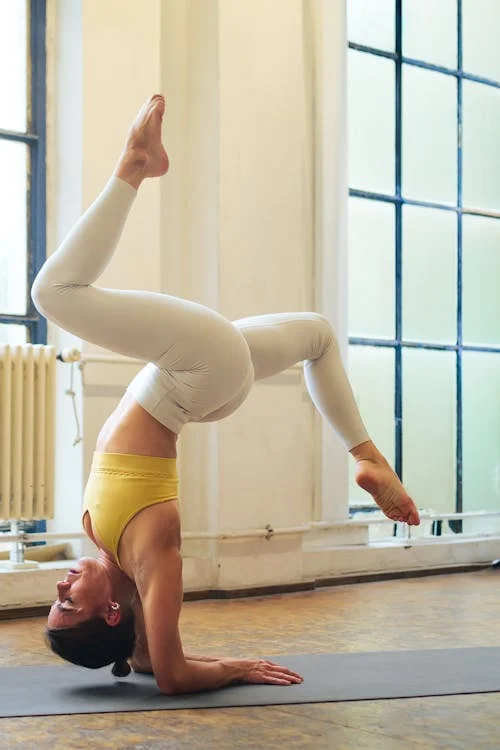
Understanding the Anatomy of Yoga Inversions
Before going upside down, it helps to have a basic understanding of the Anatomy involved. When you invert, a different set of muscles is called into action than in your typical standing poses.
The key muscle groups engaged during inversions include:
- Core muscles (rectus abdominis, obliques, transverse abdominis) — these stabilize your entire body and prevent collapse
- Shoulder girdle muscles — your rotator cuff, trapezius, and serratus anterior work together to maintain safe alignment
- Wrists and forearms — in handstands and forearm balances, these bear significant load and need consistent conditioning
- Leg muscles — keeping your legs active and engaged helps you maintain balance and alignment
Knowing which muscles work in each pose helps you train smarter, avoid injury, and build strength progressively. Think of this knowledge as your roadmap before you flip upside down.
Why Bother? The Real Benefits of Yoga Inversions
There are solid reasons why inversions have been a cornerstone of yoga traditions for centuries. Modern science backs up many of the age-old claims. Here’s what going upside down can do for you:
| Benefit | What It Means for You |
| Improved Circulation | Reversing gravity helps blood and lymphatic fluid flow more efficiently, reducing heaviness in the legs |
| Upper Body Strength | Bearing your own body weight builds real, functional strength in shoulders, arms, and core |
| Better Balance | Inversions challenge your proprioception — your brain’s sense of body position — sharpening coordination |
| Stress Relief | Gentle inversions activate the parasympathetic nervous system, calming anxiety and lowering heart rate |
| Boosted Energy | Increased blood flow to the brain delivers a natural energy lift without caffeine |
| Mental Confidence | Mastering a scary pose builds self-belief that carries well beyond your yoga mat |
Who Should Approach Inversions with Caution?
Inversions are wonderful — but they’re not for everyone at every stage. It’s important to listen to your body and consult a healthcare provider if any of the following apply to you:
- Neck or cervical spine injuries
- Uncontrolled high blood pressure
- Glaucoma or other eye pressure conditions
- History of stroke or heart conditions
- Epilepsy
- Pregnancy (especially after the first trimester)
If you fall into any of these categories, don’t despair — there are gentle, modified options (including supported poses from Restorative Yoga) that let you experience the benefits of inversions without the risks. Speak to your teacher and your doctor to find the safest approach for you.
How to Prepare for Yoga Inversions
Jumping straight into a Headstand on day one is a recipe for frustration (and potential injury). Smart preparation is what separates practitioners who thrive in inversions from those who struggle. Here’s how to set yourself up for success.
1. Build Your Foundation with Prep Poses
Certain poses are natural stepping stones toward full inversions. Spend several weeks — even months — building comfort and strength in these before attempting anything more advanced:
- Downward-Facing Dog (Adho Mukha Svanasana): Strengthens the shoulders and hamstrings, introduces the feeling of weight bearing on hands, and activates the pelvic floor.
- Dolphin Pose: Builds forearm and shoulder strength, and gets you used to the sensation of your hips rising above your head. Aim to hold this for a full minute before progressing.
- Plank and Forearm Plank: Foundational core builders that train the body to stay rigid and aligned — a skill you’ll need upside down.
- Standing Forward Fold (Uttanasana): Gently introduces inversion by dropping your head below your heart in a low-effort way.
2. Warm Up Thoroughly Before Every Session
Cold muscles and stiff joints are the enemy of a safe inversion practice. Before attempting any inverted pose, spend at least 10–15 minutes warming up. Focus on:
- Sun Salutations to heat the whole body
- Shoulder shrugs, rolls, and circles to lubricate the shoulder joints
- Wrist stretches and flexion/extension exercises to protect your wrists
- Core activation exercises such as boat pose or leg raises
3. Use the Wall as Your Best Friend
The wall is not a crutch — it’s a brilliant training tool. Practicing handstands and forearm balances at the wall lets you experience the full pose, build the right muscle memory, and eliminate the fear of falling. Use it freely and without embarrassment.
4. Train Your Pelvic Floor
This is the secret that many beginners miss. The pelvic floor — the set of muscles at the base of your pelvis — is absolutely central to balancing in inversions. In Downward Dog, try internally rotating your inner thighs toward the space behind you. This simple action engages the pelvic floor and sets the stage for stability when you flip upside down.
How to Practice Yoga Inversions: 5 Poses in Progressive Order
Work through these poses in the order listed. Each one builds the strength and confidence required for the next. Don’t rush — true mastery at each stage is far more valuable than racing to the finish line.
Pose 1: Downward-Facing Dog (Adho Mukha Svanasana)
This beloved pose is your first true inversion and a powerful one at that. It stretches the back of the legs, lengthens the spine, and builds shoulder strength.
How to do it:
- Start on all fours with hands shoulder-width apart and knees below your hips
- Tuck your toes and push your hips up and back, straightening (but not locking) your legs
- Press firmly through your palms, spreading your fingers wide
- Let your head hang freely between your arms
- Hold for 5–10 breaths, working up to 1–2 minutes
Pose 2: Dolphin Pose
Dolphin Pose is your gateway to forearm-based inversions. It’s both a shoulder opener and a strength builder — and it’s more challenging than it looks.
How to do it:
- From Downward Dog, lower onto your forearms, keeping elbows directly under shoulders
- Interlace your fingers or place palms flat on the mat
- Walk your feet toward your hands, lifting your hips toward the ceiling
- Keep your neck long and core engaged
- Hold for 30–60 seconds. Build up to 1–2 minutes before moving on
Pose 3: Legs-Up-The-Wall (Viparita Karani)
This is where Restorative Yoga meets inversions. It’s deeply calming, wonderfully accessible, and a great way to experience the circulatory benefits of being upside down without any effort or risk.
How to do it:
- Sit sideways next to a wall with your hip touching the baseboard
- Swing your legs up the wall as you lower your back to the floor
- Let your arms rest open at your sides, palms facing up
- Close your eyes and breathe deeply. Stay for 5–15 minutes
Pose 4: Supported Headstand (Salamba Sirsasana)
Often called the ‘King of Asanas’, Headstand is one of the most technical Inversions in the practice. The key is minimising pressure on the head and neck by distributing your weight through your forearms.
How to do it:
- Come to all fours and drop to your forearms, elbows shoulder-width apart
- Interlace your fingers, leaving a small cup of space between your palms
- Place the crown of your head on the floor, cradled by your hands
- Lift your hips, walking your feet toward your face
- Engage your core and slowly lift one leg, then the other (use the wall for support)
- Keep your shoulders pulling away from your ears to protect your neck
- Hold for as long as your alignment remains solid — start with 10–20 seconds
Note: Only attempt this pose once you can comfortably hold Dolphin Pose for 1–2 minutes and have good core strength. Never rush it.
Pose 5: Shoulderstand (Salamba Sarvangasana)
Shoulderstand is sometimes called the ‘Queen of Asanas’. It’s a powerful full inversion that stimulates the thyroid gland, calms the nervous system, and builds total body awareness.
How to do it:
- Lie on your back and draw both knees to your chest
- Press your palms into the floor and swing your legs up and over your head
- Place your hands on your lower back for support, fingers pointing toward the ceiling
- Slowly extend your legs toward the ceiling, stacking hips over shoulders
- Keep your elbows shoulder-width apart and your weight on the backs of your upper arms — NOT your neck
- Hold for 30 seconds to 2 minutes, breathing steadily
Common Mistakes to Avoid in Your Inversion Practice
- Skipping the warm-up: Cold muscles fatigue faster and are more prone to strain. Always heat up the body first.
- Rushing progression: Spending only a day or two with prep poses before attempting full inversions sets you up for injury. Allow weeks or months at each stage.
- Holding the breath: Inversions can trigger an instinct to grip and brace — consciously keep breathing throughout each pose.
- Collapsing into the neck: Especially in Headstand and Shoulderstand, the neck must be long and free. If you feel pressure in your cervical spine, come down immediately.
- Practicing alone before you’re ready: Have a wall or a trusted spotter when learning new inversions.
5 Practical Tips for a Smarter Inversion Practice
- Practice daily — even 10 minutes of inversion prep work each day accelerates progress more than one long weekly session.
- Use props — yoga blocks under your shoulders in Shoulderstand, or folded blankets under your forearms in Dolphin Pose, make a real difference.
- Let fear be a signal, not a stop sign — a healthy dose of nervous energy means you’re at your growth edge. Use it as a call for extra focus, not retreat.
- Track your holds — challenge yourself to add 5 seconds each week to your best hold time in each pose.
- Rest afterward — follow your inversion practice with a few minutes of Child’s Pose or Savasana to let your nervous system settle.
Frequently Asked Questions About Yoga Inversions
It varies widely depending on your existing strength and how consistently you practice. Many dedicated practitioners achieve a solid Headstand within 3–6 months of focused preparation work. Consistency and patience matter far more than talent.
Absolutely. Many inversions are beginner-friendly — Legs-Up-The-Wall, Standing Forward Fold, and Downward-Facing Dog are all inversions that require no prior experience. What’s important is starting at the right level for your body and building progressively.
Light inversions like Downward Dog or Legs-Up-The-Wall are safe for daily practice. More intense poses like Headstand and Shoulderstand are typically practiced 3–5 times per week with rest days in between, especially when you’re building up to them.
Come out of the pose slowly and carefully, then rest in Child’s Pose. Dizziness can be caused by coming up too quickly, holding the breath, or low blood pressure. Always transition into and out of inversions mindfully.
A qualified yoga teacher is genuinely valuable when learning Headstand and Shoulderstand in particular. They can spot misalignment that you can’t feel, offer physical assists, and correct common errors before they become habits. If in-person classes aren’t accessible, video guidance combined with wall practice is a good starting point.
Conclusion: Flip Your World Upside Down
Learning how to practice yoga inversions is one of the most transformative things you can do for your yoga journey. From the gentle surrender of Legs-Up-The-Wall to the triumphant moment of holding your first Headstand away from the wall, every step of this path builds something real — strength, courage, and a fresh way of seeing the world.
The key is to respect the process. Understand the Anatomy at play, build your foundation honestly, warm up every time, and use tools like Restorative Yoga to recover and restore. Most of all, enjoy the ride. Inversions are meant to be playful as much as they are challenging.
Ready to get started? Explore our related guides on Shoulderstand technique, building core strength for inversions, and creating your first inversion-focused yoga sequence. And if this guide helped you, share it with a fellow yogi who’s been curious about going upside down — you might just inspire their next breakthrough.