
So you’ve been searching for a yoga alliance certified Rishikesh school, comparing prices, reading reviews, shortlisting options — and somewhere in the middle of all that research, you’re wondering: Is Rishikesh really the place for me?
It’s a fair question. Rishikesh has a powerful reputation, and there’s genuine history behind it. But reputation and reality don’t always match, and in this case, the gap has been quietly growing for years.
This article isn’t here to dismiss Rishikesh. It deserves respect as the birthplace of modern yoga tourism and home to some genuinely dedicated teachers. What it is here to do is give you the full picture — so you can make the choice that’s actually right for you, not just the obvious one.
And if you’re open to it, there’s a quieter, greener, equally certified destination that might suit your journey far better: Dharamshala.
What Does “Yoga Alliance Certified” Actually Mean?
Before we go any further, let’s clear something up that not many people talk about openly.
Yoga Alliance is a US-based, non-profit organisation that sets curriculum standards for yoga teacher training programmes. When a school is registered with Yoga Alliance, it means their training meets a defined standard in areas like contact hours, curriculum content, and teacher qualifications. Schools carry designations like RYS 200, RYS 300, or RYS 500 — Registered Yoga School at the corresponding hour level.
Here’s the thing: Yoga Alliance doesn’t certify locations. It certifies schools. A school registered in Rishikesh carries the same RYS designation as one registered in Dharamshala, Bali, or Barcelona. Your certificate — and your eligibility to register as an RYT (Registered Yoga Teacher) globally — is identical regardless of where your school is based.
So when you search “yoga alliance certified Rishikesh” and see hundreds of options, what you’re really looking for isn’t a Rishikesh certification. You’re looking for a Yoga Alliance-registered school that gives you the best possible training environment. And that’s where this conversation gets interesting.
Why Everyone Defaults to Rishikesh (And Why That’s Worth Questioning)
Rishikesh earned its title as the Yoga Capital of the World for real reasons. Sitting at the foothills of the Himalayas in Uttarakhand, with the Ganga flowing through it, the city has attracted seekers, sages, and students for generations. The ashram culture runs deep. The tradition is real.
But something shifted over the past decade or so. As yoga tourism exploded globally, Rishikesh became the obvious answer to the question “where do I do my yoga teacher training?” — and where there’s demand at scale, supply follows. Today, the city is home to hundreds of schools running multiple batches every single month.
That growth has consequences worth thinking about.
The Crowded Dorm Reality
Walk into the accommodation section of most Rishikesh schools — especially those in the popular mid-range bracket — and you’ll find shared rooms housing four to eight students. On paper, it sounds manageable. In practice, it means you’re returning after six to eight hours of intense physical training, yoga philosophy classes, and emotional introspection, only to share a room with strangers on different sleep schedules, different noise levels, and different ideas of personal space.
[Yoga teacher training courses] are immersive journeys. The transformation doesn’t happen only on the mat — it happens in the quiet hours between sessions, in the early morning before pranayama, in the moments when you need to sit with your own thoughts. That requires personal space. In most Rishikesh schools running on volume, that space is genuinely hard to come by.
Building Next to Building — Not Quite the Nature Retreat You Imagined
Every school in Rishikesh, including those in Tapovan, claims to offer a natural, serene environment. And to be fair, the mountains are there. The Ganga is there. But the distance between you and them is often more than the brochures suggest.
Tapovan and the surrounding areas have been built up steadily and densely. Cafés, souvenir shops, motorbikes, construction noise — the area has the energy of a busy tourist town, not a contemplative retreat. A handful of schools have genuine riverside access or proper forest settings, but they’re the exception rather than the rule. Most of the time, you’re training in a rooftop shala or an indoor studio, with the Himalayas visible somewhere in the background if you look in the right direction.
That’s not necessarily a dealbreaker. But it is a gap between what’s marketed and what’s experienced — and it matters when you’re spending 28 days trying to go inward.
When Yoga Becomes a Market, Not a Transmission
There’s something harder to articulate about what’s happened to the teacher-student relationship in heavily commercialised yoga markets — but most serious practitioners feel it when they arrive.
In the traditional understanding of yoga, a teacher didn’t just instruct postures. They held responsibility for a student’s growth — and that meant honesty, rigor, and sometimes a kind of loving strictness that pushed students past comfortable limits. The teacher taught because it was their dharma, not because they had ten batches to fill this month and needed positive reviews.
In a market with hundreds of competing schools, customer satisfaction starts to drive decisions that should be driven by teaching values. Schools soften feedback. Teachers avoid conflict. The emphasis shifts toward experience design — nice meals, weekend excursions, a graduation ceremony with photos — rather than depth of transmission.
Rishikesh still has teachers of genuine calibre. But the structural pressure of operating inside the world’s busiest yoga market works against the conditions that deep teaching requires. That’s worth knowing before you book.
Dharamshala: The Same Certification, A Different World
Now let’s talk about Dharamshala.
Nestled in the Kangra Valley of Himachal Pradesh at around 1,457 metres above sea level, Dharamshala — and its upper village of McLeod Ganj — offers something increasingly rare in India’s yoga education landscape: genuine quietness, real nature, and a learning environment that hasn’t yet been overwhelmed by the market forces reshaping Rishikesh.
And yes, schools here are fully [Yoga Alliance registered], offering the same 200hr, 300hr, and 500hr programmes that lead to internationally recognised RYT credentials.
The Air Is Different — Literally
This sounds poetic, but it has a practical effect. Dharamshala’s elevation brings cooler, cleaner air and a noticeably different atmosphere for morning practice. Pranayama in crisp mountain air, with cedar forests on the hillside and unobstructed Himalayan views, is a different experience from practicing in a heated valley town. Conditions like these aren’t incidental — they actively support the depth of practice that teacher training demands.
The climate also allows year-round practice without the extreme summer heat or monsoon humidity that can make Rishikesh uncomfortable at certain times of year.
Nature Is the Default, Not the Backdrop
In Dharamshala, you don’t have to find your way to nature between sessions. Nature is what you’re surrounded by from the moment you step outside. Cedar and rhododendron forests, mountain trails, clean air, and genuine altitude — it’s built into the geography. Schools here don’t need to market a “natural setting” because it’s simply the reality of the location.
This matters for something less talked about in yoga teacher training discussions: the cumulative effect of your environment over 28 days. Where you wake up, what you look at, what you breathe, whether there’s silence or noise outside your window — these things quietly shape the quality of your inner work.
Smaller Batches, More Personal Space
Because Dharamshala hasn’t been absorbed into mass yoga tourism the way Rishikesh has, the schools that operate here tend to be smaller, more selective, and more boutique by nature. Batch sizes are genuinely small. Accommodation tends toward private or semi-private rooms rather than dormitories.
This isn’t a luxury upgrade for its own sake. Private space during a [200 hour yoga teacher training] changes the depth of what’s possible. When you’re not managing shared-room dynamics, you can actually process what the training is doing to you — and that’s where the real transformation happens.
A Cross-Traditional Spiritual Atmosphere
Dharamshala carries a spiritual weight that’s different from Rishikesh — and in many ways, complementary to yoga practice. The town is home to the Tibetan exile community, including the Dalai Lama’s residence and numerous active monasteries. Living alongside a culture that takes contemplative practice seriously — where monks walk the same streets you do, where Tibetan Buddhist philosophy is woven into everyday life — quietly elevates the environment in ways that are hard to describe and easy to feel.
For students drawn to yoga as a genuine inner practice rather than a certification exercise, this matters.
Mahiyoga School: Where All of This Comes Together
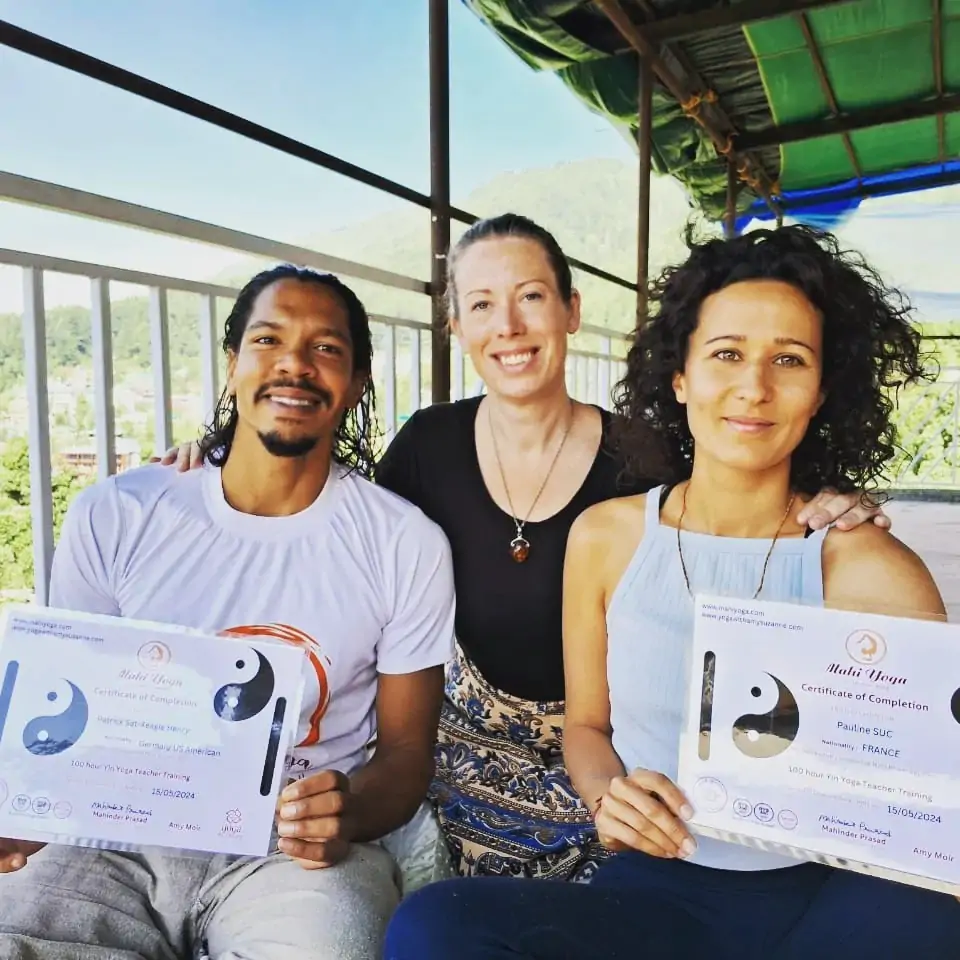
Mahiyoga School in Dharamshala is exactly the kind of teaching environment this article is pointing toward. Small batches. Private and semi-private accommodation. Experienced teachers rooted in traditional lineages. A location where the Himalayan landscape is your actual daily backdrop, not a distant promise.
The school offers [200 hour yoga teacher training in Dharamshala], [300 hour yoga teacher training], and [yoga retreats in Dharamshala] — all registered under Yoga Alliance standards. The certification you receive here carries the same global weight as anything issued in Rishikesh. The difference is everything that happens around the certification.
A Side-by-Side Look: Rishikesh vs Dharamshala for YTTC
| Factor | Rishikesh | Dharamshala (Mahiyoga) |
|---|---|---|
| Yoga Alliance Certification | ✅ Yes | ✅ Yes (identical credential) |
| Environment | Urban, busy, built-up | Forested, quiet, high altitude |
| Accommodation | Often shared dorms (4–8 students) | Private / semi-private rooms |
| Batch Size | Typically 16–25+ students | Small, intentional batches |
| Crowd Level | Very high (peak season) | Low to moderate year-round |
| Spiritual Atmosphere | Traditional Hindu, river town | Yoga + Tibetan Buddhist, contemplative |
| Temperature | Hot valley summers, humid | Cool, crisp mountain air year-round |
| Teacher-Student Ratio | Varies widely | High attention, smaller groups |
| Authenticity of Instruction | Ranges from excellent to commercial | More consistent in smaller schools |
This Isn’t About One City Being Better Than Another
Rishikesh is special. If you go there, you will feel something — the energy of the Ganga, the bell sound from temples at dusk, the weight of a place that has held yoga practice for so long. Some of the finest yoga teachers working today trained there, and some of the city’s best schools still maintain genuine depth.
But “special” and “right for your teacher training” are different questions.
If you’re someone who needs personal space to go inward, who wants nature to be genuinely present rather than marketed, who wants a teacher-student relationship that isn’t shaped by review culture and batch volume — then the yoga alliance certified Rishikesh result sitting at the top of your search page may not actually be what you need.
Dharamshala, and specifically Mahiyoga School, offers the same internationally recognised credential alongside conditions that are structurally more aligned with what transformative yoga training actually requires.
FAQ: Yoga Alliance Certified YTTC in Rishikesh and Dharamshala
Yes, completely. Yoga Alliance accredits the school, not the city. Whether your school is registered in Rishikesh, Dharamshala, or anywhere else in the world, the certification and your eligibility to register as an RYT are identical. Employers and studios worldwide recognise the Yoga Alliance standard regardless of where the training was completed.
Absolutely. The 200 hour YTTC is specifically designed to work for both beginners who want to deepen their practice and those who intend to teach. A smaller, more intimate setting like Mahiyoga School in Dharamshala can actually be a better environment for beginners, since the personal attention from teachers is higher when batch sizes are small.
Dharamshala’s climate makes it suitable for most of the year. February to May and September to November are generally the most comfortable seasons, with clear skies and cool temperatures. The monsoon (July–August) brings heavy rain but also exceptional greenery. Unlike Rishikesh, the summer heat in Dharamshala is mild at altitude, making it a more comfortable choice for June practice as well.
Before enrolling in any school, verify their registration directly on the Yoga Alliance website at yogaalliance.org. Search for the school by name and confirm their RYS status at the relevant hour level (RYS 200, RYS 300, etc.). A legitimate school will have an active listing. Also check their registration date and whether their status is current — some schools list lapsed registrations without disclosing this.
Yes. Dharamshala and McLeod Ganj have a long history of welcoming international visitors, particularly due to the Tibetan community and the presence of the Dalai Lama’s residence. The town has good infrastructure for travellers, including reliable accommodation, cafés, medical facilities, and transport connections to Delhi (roughly 10–12 hours by road or overnight bus, with the nearest airport at Gaggal/Kangra, about an hour away).
Ready to Think Beyond Rishikesh?
If this has shifted something in how you’re thinking about your training, that’s exactly the point. The yoga alliance certified Rishikesh route is well-trodden for good reason — but well-trodden paths aren’t always the most transformative ones.
Take a look at what [Mahiyoga School in Dharamshala] offers. Read about their [200 hour yoga teacher training programme], their [yoga retreat options], and the kind of environment they’ve built. Then ask yourself — not where it’s easier to go, but where you actually want to spend 28 days of your life going inward.
Have questions, or thinking about making the switch to Dharamshala? Drop them in the comments — we’re happy to help you find the right fit.